
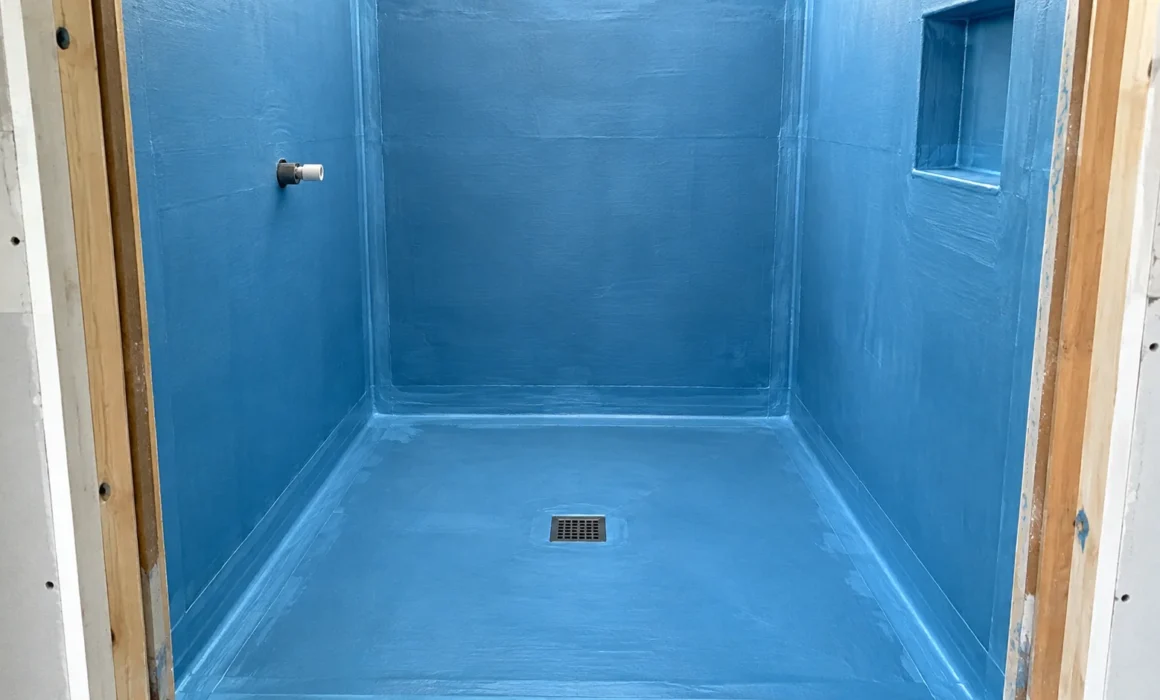
Shower Waterproofing Membrane: Types, Failure Signs and Repair Options
Tiles and grout are not what keeps a shower watertight. The real barrier is the shower waterproofing membrane, a thin flexible layer hidden under the tiles that you will never see unless something goes wrong. When it works, nobody thinks about it. When it fails, water moves into the wall frame, the subfloor and the room next door. This guide explains what a shower membrane is, the types used in Australian bathrooms, why they fail, and how to tell whether your leak is a membrane problem or something much cheaper to fix.
In short: A shower waterproofing membrane is a continuous waterproof layer applied to the shower floor and walls before tiling. It catches the water that passes through grout and directs it to the drain. In Australia, shower membranes must comply with AS/NZS 4858 and be installed to the National Construction Code.
Why a shower needs a membrane at all
Cement grout is porous. Every shower pushes a small amount of water through the grout lines and into the tile bed. Tiles slow water down. They do not stop it.
The membrane sits underneath and does the stopping. It forms a tray across the floor, turns up the walls and seals into the drain, so any water that gets under the tiles has only one way out.
Where the membrane has to go
For houses, the NCC Housing Provisions Part 10.2 set the minimum. In a shower area:
- the floor must be waterproof, including any hob or step-down
- walls must be waterproof to at least 1800 mm above the floor
- wall junctions must be waterproof for at least 40 mm either side of the joint
- wall and floor junctions must be waterproof
- all penetrations, such as taps and the shower rose, must be waterproof
- the membrane must finish at or in a drainage flange, so it connects to the waste
The same provisions require a bond breaker at every wall-to-wall and wall-to-floor junction. More on that below, because it is where many membranes fail. Our guide to Australian waterproofing standards covers the rest of the bathroom.
Types of shower waterproofing membrane
Two broad families are used in Australian showers: liquid-applied membranes and sheet membranes.
| Type | How it is applied | Strengths | Watch-outs |
|---|---|---|---|
| Water-based acrylic or latex liquid | Brushed or rolled in two or more coats | Easy to apply, low odour, widely available | Needs correct thickness and full cure before tiling |
| Polyurethane liquid | Brushed, rolled or trowelled | Very flexible, strong water resistance | Solvent odour in some products, primer and tile adhesive must be compatible |
| Cementitious | Mixed and brushed or trowelled | Bonds well to masonry and tile adhesive | Less flexible, so less tolerant of movement |
| Sheet membrane | Pre-formed sheets bonded to the substrate with sealed overlaps | Factory-controlled thickness, quick to tile over | Every seam and corner depends on careful installation |
No single type is best in every bathroom. A flexible liquid membrane suits a timber-framed upper floor that moves. A sheet system suits a job that has to be tiled quickly. The installer’s care matters more than the brand.
Membrane classes
AS/NZS 4858 classifies wet area membranes into Class I, II and III by how far they can stretch before breaking. Class III products stretch the most. The class decides how junctions are detailed, including the size and type of bond breaker. Ask your waterproofer which class they are using and why.
Why shower membranes fail
Most failures are installation faults, not product faults. Victoria’s building regulator names two common ones in its wet area waterproofing guidance: pinholing, caused by applying the membrane too thickly in a single coat, and poor adhesion, caused by inadequate surface preparation.
In the showers we open up, these causes come up again and again:
- No bond breaker at the junctions. Walls and floors move independently. A membrane bonded hard into the corner tears. A bond breaker lets it stretch across the joint.
- Dusty or damp substrate. The membrane peels because it never bonded.
- Coats too thin, too thick or too few. Thin coats leave gaps. One thick coat traps air and forms pinholes.
- Tiling before the membrane has cured. The adhesive softens it.
- A poor connection at the waste. Without a drainage flange, water under the tiles runs past the drain and into the floor.
- Punctures. Screws for shower screens and shelves driven through the membrane.
- Building movement. Reactive soils and timber shrinkage open cracks that a low-flexibility membrane cannot bridge.
The scale of the problem is well documented. The QBCC lists internal wet area waterproofing membranes among the top five structural defect types reported in Queensland, according to its published defect analysis.
How to tell if your membrane has failed
You cannot see the membrane, so you read the symptoms around it:
- damp or bubbling paint on the wall behind the shower
- swollen skirting boards, architraves or vanity kickboards
- carpet or timber flooring that stays damp near the bathroom
- a ceiling stain under an upstairs shower
- tiles that sound hollow or have come loose
- mould or a musty smell that returns soon after cleaning
- efflorescence, a white crust on grout lines
These signs prove that water is escaping. They do not prove the membrane is the cause. Cracked grout, failed silicone and unsealed tap penetrations produce exactly the same symptoms, and they are far more common. Our list of 9 warning signs of a leaking shower seal explains each one.
That is why testing comes before quoting. Shower leak detection with pressure and moisture testing shows where water is entering, so you repair the actual fault.
Can a failed shower membrane be repaired without removing tiles?
Sometimes. It depends on what has failed and how far the damage has gone.
When sealing works. If water is entering through grout lines, junctions, the waste surround or penetrations, those entry points can be closed from the surface. The failed grout and silicone are removed, the joints are rebuilt with flexible materials, and the tiled surface is sealed. Water no longer reaches the membrane layer in volume, so the leak stops. This is how we fix a leaking shower without removing tiles.
When a rebuild is needed. If the substrate has rotted, tiles are loose across a wide area, or there was never a membrane at all, surface sealing will not last. The shower has to be stripped, the substrate repaired, a new membrane applied and the area retiled. Our article on whether to rebuild or repair a leaky shower walks through that decision.
Be wary of anyone who quotes a full rebuild without testing first. Be equally wary of anyone who promises a surface seal will fix a shower with a soft, spongy floor.
Questions to ask before a new membrane goes in
If you are renovating or rebuilding, ask the waterproofer:
- Which product are you using, and does it comply with AS/NZS 4858?
- Which class is it, and what bond breaker goes at the junctions?
- How many coats, and how long between coats?
- How long will it cure before tiling?
- Is a drainage flange being fitted at the waste?
- Will you photograph the finished membrane before it is covered?
- What is your QBCC licence number?
In Queensland, building work over $3,300 requires a QBCC licence. Photos and a written record of the product are worth having. They are your evidence if a defect appears years later.
How long should a membrane last?
A correctly installed membrane should last for many years and often for the life of the tiling. A poorly installed one can leak within months. Workmanship, building movement and the product itself all play a part. We cover the detail in how long shower waterproofing lasts.
Conclusion
The shower waterproofing membrane is the part of your bathroom that does the real work of keeping water in. Most failures trace back to installation: missing bond breakers, poor preparation and rushed curing. The symptoms look the same as a simple grout or sealant failure, so a proper test should always come before a repair decision.
Leaky Showers tests first, then recommends the smallest repair that will fix the leak for good, whether that is a tile-on seal or a rebuild. We work across Brisbane, Logan and the Gold Coast. Get a free quote today.
Frequently Asked Questions
What is a shower waterproofing membrane?
A shower waterproofing membrane is a continuous waterproof layer applied to the shower floor and walls before tiling. It stops water that passes through grout from reaching the wall frame and subfloor, and directs it to the drain. It may be a liquid coating or a bonded sheet.
Which membrane is best for a shower?
There is no single best product. Flexible liquid membranes suit most domestic showers, especially on timber floors that move. Sheet membranes give consistent thickness and fast tiling. Whichever is used, it must comply with AS/NZS 4858 and be installed with bond breakers and a drainage flange.
How many coats of waterproofing does a shower need?
Follow the manufacturer’s instructions, which usually specify at least two coats applied in different directions to reach a minimum thickness. One thick coat is not a substitute. Regulators warn that thick single coats cause pinholing, where trapped air leaves tiny holes in the cured membrane.
How long should waterproofing dry before tiling?
It depends on the product, the number of coats, and the temperature and humidity on the day. Some membranes can be tiled the next day, while others need several days. Check the product data sheet and do not let anyone tile over a membrane that is still soft.
Can you waterproof over existing shower tiles?
Clear sealers and tile-on sealing systems can close off porous grout and junctions over existing tiles, and this stops many leaks. They do not create a new membrane underneath. If the substrate is damaged or the tiles are loose, the shower needs to be rebuilt instead.
Do tiles and grout make a shower waterproof?
No. Tiles shed most water, but cement grout is porous and lets moisture through to the tile bed. The membrane under the tiles is what makes a shower waterproof. This is why a shower with perfect-looking tiles can still leak into the wall.
Does shower waterproofing need a certificate in Queensland?
Ask your contractor for a written statement or certificate that records the product, the areas treated and the date. Building certifiers commonly ask for one on new work and renovations that need approval. Keep it with photos of the membrane, because it helps with defect claims and when you sell.